

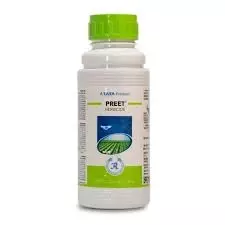
Preet Herbicide
Available Offer
Preet Herbicide (Pretilachlor 50% EC) by Rallis India | Expert Weed Control for Rice
Stop weeds before they start with the power of Pretilachlor.
Preet Herbicide, a flagship product from Rallis India Limited (A Tata Enterprise), is the trusted solution for millions of paddy farmers. Designed specifically for transplanted rice, this pre-emergence herbicide creates a powerful chemical barrier in your field. By applying Preet within the first few days of transplanting, you eliminate competition from grasses, sedges, and broad-leaved weeds, ensuring your crop gets 100% of the nutrients and sunlight it needs for maximum yield.
Save on labor costs and protect your harvest with the reliability of Tata.
Why Choose This Product? Key Benefits
- ⏱️Early Action: Stops weed germination immediately (0-5 Days After Transplanting), protecting the crop during its most critical growth phase.
- ?️Broad Spectrum Control: One solution for all major threats: tough grasses like Barnyard grass, stubborn sedges, and broad-leaved weeds.
- ⏳Long-Lasting Protection: Provides residual control for 30-40 days, replacing the need for expensive manual weeding labor.
- ?️Water Friendly: Ideally suited for wet conditions; works perfectly in standing water and adapts to the "Sand Mix" broadcasting method.
- ?Crop Safety: Highly selective to transplanted rice, ensuring the weeds die while your paddy thrives (safe for established root systems).
Technical Specifications
| Parameter | Details |
|---|---|
| Brand Name | Preet |
| Technical Name | Pretilachlor 50% EC |
| IRAC MoA Code | Group 15 (Formerly K3) |
| Chemical Group | Chloroacetamide |
| Formulation | Emulsifiable Concentrate (EC) |
| Toxicity Label | Blue Triangle (Moderately Toxic) |
How It Works: Mode of Action
Preet acts as a growth inhibitor targeting weed seedlings before they emerge from the soil.
- Uptake: The herbicide is absorbed rapidly by the shoots (coleoptiles) and roots of germinating weed seeds.
- Cellular Blockage: It inhibits the synthesis of Very Long Chain Fatty Acids (VLCFA), which are essential for cell division and cell growth.
- Elimination: Without new cells, the weed seedling stops growing, fails to emerge from the soil surface, and dies within days.
Target Crops & Pests
| Crop | Target Pest(s) |
|---|---|
| Transplanted Rice (Paddy) | Barnyard Grass (Echinochloa crus-galli) |
| Transplanted Rice (Paddy) | Small-flower Umbrella Sedge (Cyperus difformis), Rice Flatsedge |
| Transplanted Rice (Paddy) | Broad-leaved weeds (Ludwigia parviflora, Eclipta alba) |
Dosage & Application Guide
The Golden Rule: Always follow the "Dose per Acre" for accurate results. Adjust dose slightly higher for heavy clay soils and lower for light sandy soils.
Dosage per Acre, Litre, & Pre-Harvest Interval (PHI)
| Crop | Dose (ml / Acre) | Water (L / Acre) | Dose (ml / Litre) | PHI (Days) |
|---|---|---|---|---|
| Transplanted Rice | 500 ml - 750 ml | 200 Liters (Spray) or Sand Mix | 2.5 - 3.75 ml | 75 - 90 Days |
*PHI = Pre-Harvest Interval: The minimum number of days to wait between the last spray and harvesting.
How to Apply: Best Practices
- Timing: Apply strictly between 0 to 5 Days After Transplanting (DAT). Effectiveness drops significantly if weeds have already emerged (2-3 leaf stage).
- Mixing (Sand Method): Mix the recommended dose with 20-25 kg of dry sand or fertilizer (Urea). Broadcast uniformly over the field.
- Coverage (Water Management): Maintain 2-3 inches of standing water in the field for 3-5 days after application. This water acts as a carrier to spread the chemical and form a barrier.
- Safety: Always wear PPE (gloves, mask, goggles). Wash hands thoroughly after use. Do not drain water immediately.
Frequently Asked Questions
1. Can I use Preet for Direct Seeded Rice (DSR)?
No. Preet 50% EC is recommended for transplanted rice. For DSR, a safener (like Fenclorim) is usually required to prevent crop injury; consult an agronomist for DSR-specific formulations.
2. What happens if it rains heavily after application?
Moderate rain is fine, but heavy rain causing water runoff can wash the herbicide away, reducing control and potentially harming nearby water bodies. Ensure field bunds are secure.
3. Can I mix Preet with other herbicides?
Yes. Farmers often mix Preet with Almix (Metsulfuron + Chlorimuron) to enhance control over broad-leaved weeds and sedges, creating a potent broad-spectrum solution.
4. Why do I need standing water?
Standing water allows the herbicide to emulsify and spread evenly across the field. It also suppresses aerobic weed germination, acting as a secondary weed control method.
5. Is there an antidote for accidental poisoning?
There is no specific antidote. Treatment is symptomatic and supportive. Note: Symptoms may mimic organophosphate poisoning, but treatment differs. Seek immediate medical attention.
Safety & Disclaimer
Always read and follow the instructions on the official product label. The information provided here is for guidance only. Use personal protective equipment (PPE) during application. Do not use near aquaculture ponds as it is toxic to fish.